Trauma-Informed Yoga Teacher Training (24 CE Hours: Non-Clinical)
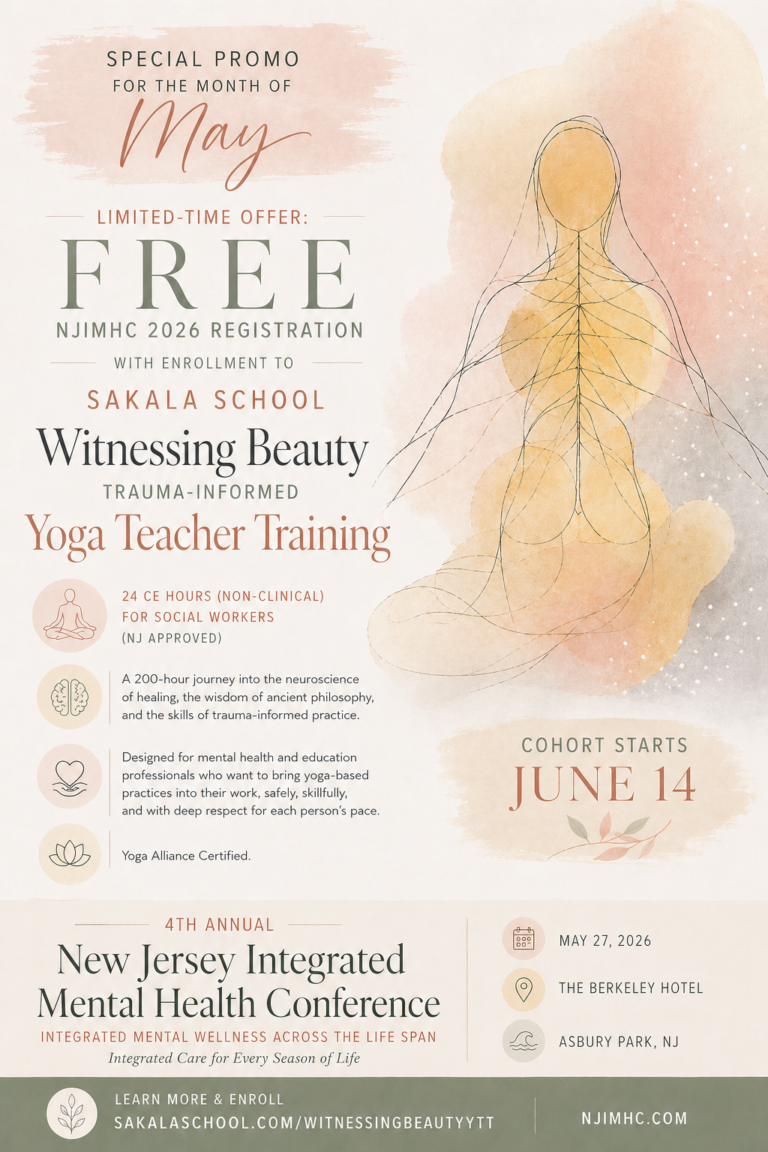
This 24-hour continuing education module is a designated segment within our 200-hour Trauma-Informed Yoga Teacher Training program.
Participants must enroll in the full 200-hour program. Social workers seeking CE credit will complete this 24-hour module as part of the full training.
This 24-hour continuing education module is offered within a 200-hour Trauma-Informed Yoga Teacher Training program registered with Yoga Alliance. While the full program prepares participants for Registered Yoga Teacher (RYT) certification, these 24 hours are approved for social work continuing education and focus specifically on nervous system education, stress physiology, and trauma-informed teaching practices.
Participants learn how physiological states influence behavior, attention, and engagement, and how body-based awareness can be integrated into clinical, educational, and community settings in ways that align with professional scope and ethics.
The curriculum draws from neuroscience, stress physiology, and somatic education to support understanding of regulation, co-regulation, and the role of environment, language, and pacing in trauma-informed care. Emphasis is placed on practical application, including the use of invitational language, recognition of safety and stress cues, and facilitation approaches that support participant autonomy.
Content is delivered through instruction, guided reflection, and experiential learning, with opportunities to practice applied skills. This course is educational in nature and does not provide psychotherapy training or clinical supervision. A post-course assessment (70% passing score) is required to receive CE credit.
Related professionals (MFTs, counselors, rehabilitation and substance use professionals) whose boards accept NASW-NJ approved credits
Social workers in states that recognize NASW-NJ CE approval
Participants are responsible for confirming CE acceptance with their licensing board.
Continuing Education - Learning Objectives
Upon completion of this 24-hour course, participants will be able to:
Describe key concepts in trauma and stress physiology as they relate to behavior and engagement
Explain how nervous system states influence regulation, attention, and interaction
Translate foundational neuroscience concepts into accessible, non-clinical language
Apply trauma-informed teaching principles including choice, pacing, and environmental awareness
Identify cues of safety and stress in group or individual settings
Demonstrate basic skills for supporting co-regulation and body-based awareness
Differentiate between trauma-informed education and clinical intervention
Develop a simple facilitation plan integrating nervous system awareness and trauma-informed language
Course Structure
The course is organized into eight sessions that progressively build understanding and application of:
Trauma and stress physiology
Nervous system regulation and resilience
Breath and body-based awareness
Systemic responses to stress (cardiovascular, endocrine, digestive)
Autonomic nervous system and polyvagal-informed frameworks
Trauma-informed facilitation and learning environments
Each session integrates education with applied practice to support real-world use in professional settings.
Continuing Education Teacher/Trainer
Judy Thompson, MS, holds a Master of Science in Yoga Therapy and has over ten years of experience designing and teaching professional education for mental health and education professionals. She is the founder and lead faculty of a 200-hour Trauma-Informed Yoga Teacher Training delivered over 25 weeks, now in its sixth cohort. In this role, she developed the curriculum, teaches the core content, and oversees instructional design and evaluation. Her graduate training in yoga therapy and applied neuroscience education provides the foundation for the course content, which includes trauma-informed principles, nervous system and stress physiology, and facilitation skills taught within a clearly defined educational scope. The program she leads is structured around measurable learning objectives, sequenced instruction, applied exercises, and participant evaluation methods consistent with continuing education standards. Her sustained experience delivering multi-session training to adult professionals supports the practical, skills-based focus of this 24-hour CE module.
CE Approval Information
This course, Trauma-Informed Yoga Teacher Training (24 CE Hours – Non-Clinical), Approval #033022026- 140, provided by Sakala School of Integrative Teaching is approved for continuing education by the New Jersey Social Work Continuing Education Approval Collaborative, which is administered by NASW-NJ. CE Approval Collaborative Approval Period: Monday, March 30, 2026 through August 31, 2028. New Jersey social workers will receive 24 CE credits for participating in this course.
Requirements for CE Credit
To receive CE credit, participants must:
Attend all 8 designated CE sessions in full.
Sign in and out for each CE-eligible time block.
Complete the post-course evaluation.
Complete a post-course test with 70% passing score.
Registration & Fees
Enrollment in the full 200-hour Witnessing Beauty: Trauma-Informed Yoga Teacher Training is required to participate in this continuing education module.
Contact Information
For questions about the continuing education training please send an email to hello <@> sakalaschool.com